The Future of Hypercars: Electrification, Autonomy, and the Next Performance Frontier
The future of hypercars: how electrification, solid-state batteries, hybrid V16 powertrains, 3D printing, active aero, autonomy and eFuels redefine performance.…
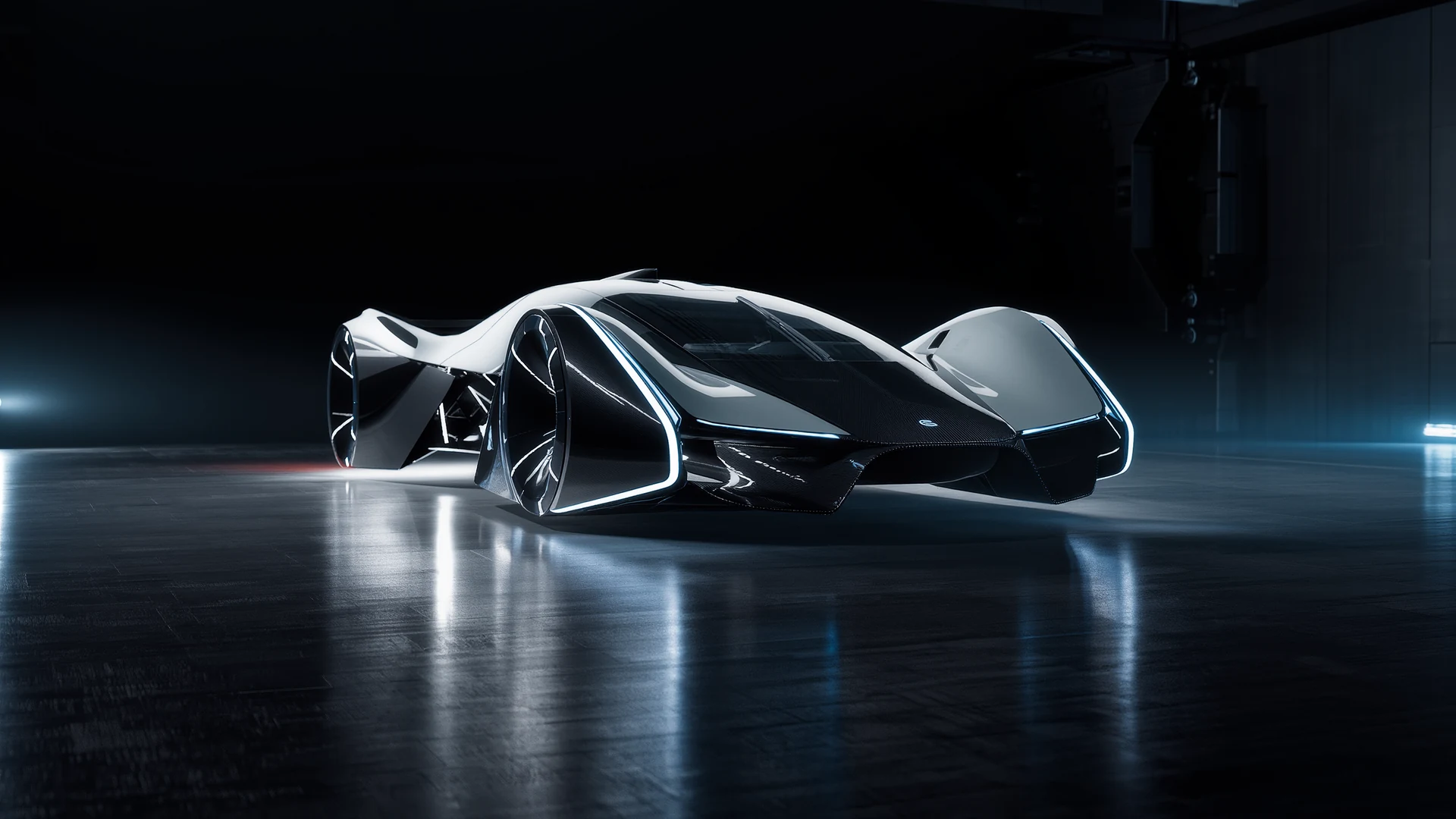
The future of hypercars is defined by electrification, hybrid V16 and V6 powertrains, solid-state batteries, 3D-printed structures, active aerodynamics, optional autonomy, and carbon-neutral eFuels.
Key Takeaways
- The Rimac Nevera set 23 acceleration and braking records in a single day at Papenburg, Germany in May 2023, hitting 0-60 mph in 1.74 seconds and completing the 0-400-0 km/h run in 29.93 seconds.
- Solid-state batteries promising 400-500 Wh/kg could cut a 120 kWh pack from about 700 kg to 300-350 kg, with Toyota targeting production by 2027-2028 and Samsung SDI commercial output by 2027.
- Hybrid hypercars like the Bugatti Tourbillon (naturally aspirated 8.3-liter V16 plus three electric motors, 1,800 hp) and Ferrari F80 (twin-turbo V6 from the 499P Le Mans program, over 1,200 hp) may mark the golden age of hypercar powertrains.
- The Czinger 21C uses the Divergent Adaptive Production System (DAPS) to 3D-print AI-designed aluminum parts that can weigh 40 percent less than forged equivalents while matching their stiffness.
- Next-generation materials including graphene (200 times stronger than steel), carbon nanotubes, self-healing composites, and structural batteries are set to challenge carbon fiber's dominance.
- Autonomous features will handle tedious driving like city traffic and parking, and could enable cars to self-deliver between cities, but manufacturers will keep them defeatable with a button to turn it all off.
- Porsche's Haru Oni plant in Punta Arenas, Chile produces carbon-neutral eFuel, while Koenigsegg's Angelholm factory runs on 100 percent renewable energy.
The Electric Revolution Arrives
For more than a century, the hypercar formula was governed by a simple equation: more cylinders, more displacement, more forced induction, more speed. That era is ending. The electric hypercar has arrived, and it has not merely matched its combustion-powered predecessors, it has humiliated them in measurable performance metrics. The transition is the most consequential development in the hypercar industry since the introduction of the mid-engine layout, and its implications reach far beyond the stopwatch.
Rimac Nevera: The Watershed Moment
If a single vehicle marks the inflection point between the combustion era and the electric era, it is the Rimac Nevera. When Mate Rimac founded his company in 2009, converting a 1984 BMW E30 to electric propulsion in his garage, the idea of an electric hypercar seemed absurd. Twelve years later, the Nevera delivered performance figures that no combustion car in history could approach: 0bis60 mph in 1.74 seconds, 0bis100 mph in 3.21 seconds, and a standing quarter-mile in 8.25 seconds, all on street-legal tires, with air conditioning, and without a drop of gasoline.
23 Records in a Single Day
In May 2023, Rimac took a production Nevera to the Automotive Testing Papenburg facility in Germany and set 23 acceleration and braking records in a single day. The records covered every traditional benchmark, 0bis60, 0bis100, 0bis200, quarter-mile, half-mile, and included the 0bis400bis0 km/h (0bis249bis0 mph) metric that Bugatti had previously owned. The Nevera completed the 0bis400bis0 run in 29.93 seconds, shattering the Chiron’s time of 41.96 seconds by a staggering 12 seconds. For context, the Chiron took 32.6 seconds just to reach 400 km/h, during that same period, the Nevera had already reached 400 km/h and come to a complete stop.
What the Nevera Proved About Electric Performance
The Nevera’s significance extends beyond the numbers. It proved that electric hypercars are not merely fast in a straight line but dynamically capable. The Nevera’s torque vectoring system, enabled by four independent electric motors, one per wheel, provides a level of chassis control that is physically impossible with a mechanical differential. The system can apply positive torque to one rear wheel and regenerative braking to the opposite rear wheel simultaneously, rotating the car into a corner with precision that no mechanical limited-slip differential can match. On the Nürburgring Nordschleife, the Nevera clocked 7:05.298, placing it among the fastest production cars in history. It also proved the viability of electric hypercars as actual usable vehicles: the Nevera offers 490 kilometers of WLTP range, a luxurious interior with three screens, and a ride quality that makes it genuinely drivable on public roads, capabilities that previous electric performance cars had promised but never delivered.
Pininfarina Battista and Lotus Evija: The Electric Cohort
The Nevera is not alone. The Pininfarina Battista, which shares the Nevera’s 120 kWh battery pack and four-motor powertrain architecture, took the electric hypercar formula in a different direction, emphasizing Pininfarina’s design heritage and coachbuilding tradition over the raw engineering narrative that Rimac pursued. With 1,900 horsepower and similar performance figures, the Battista demonstrated that the electric hypercar segment could support multiple interpretations. The Lotus Evija, meanwhile, represents Britain’s contribution to the electric hypercar era. With a target output of 2,000 horsepower, an F1-inspired carbon-fiber monocoque, and a target weight of 1,680 kilograms, the Evija brings Lotus’s decades of lightweight engineering expertise to the electric formula. The fact that three separate manufacturers, from Croatia, Britain, and Italy, can produce fundamentally similar electric hypercars with meaningfully different characters suggests that the segment is maturing faster than even its most optimistic proponents predicted.
The Solid-State Battery Promise
The current generation of electric hypercars uses lithium-ion battery technology that, while impressive, imposes fundamental constraints on weight and packaging. The Nevera’s 120 kWh battery pack weighs approximately 700 kilograms, nearly a third of the car’s total mass. Solid-state batteries, which replace the liquid electrolyte in conventional lithium-ion cells with a solid electrolyte, promise to change this equation fundamentally.
Timeline to Production
Solid-state batteries have been “five years away” for at least a decade, but the consensus among battery researchers and automotive industry analysts is that the technology is now genuinely approaching production readiness. Toyota has announced plans to introduce solid-state batteries in production vehicles by 2027bis2028, initially in hybrids before scaling to full electric vehicles. Samsung SDI, a major battery supplier, has established a pilot production line for solid-state batteries and plans commercial production by 2027. For the hypercar segment, where price sensitivity is minimal and the performance benefits are most directly applicable, solid-state adoption could occur even earlier, potentially in limited-production hypercars by 2028bis2029.
Weight Reduction and Energy Density Gains
The performance implications of solid-state batteries for the hypercar segment are transformative. Solid-state batteries promise energy densities of 400bis500 Wh/kg, compared to approximately 260 Wh/kg for the best current lithium-ion cells. This would reduce the weight of a 120 kWh battery pack from 700 kilograms to approximately 300bis350 kilograms, a savings of nearly 400 kilograms, equivalent to removing four adult passengers from the vehicle. A sub-1,300 kilogram hypercar with 2,000+ horsepower, roughly the weight of a Mazda MX-5 Miata with the power of three Formula 1 cars, moves from fantasy to plausible engineering proposition. Such a vehicle would redefine the boundaries of acceleration, cornering, and braking performance.
The Hybrid Golden Age
While the fully electric hypercar represents the long-term destination, the near term belongs to the hybrid. The current generation of hybrid hypercars, the Bugatti Tourbillon, Ferrari F80, Lamborghini Revuelto, Aston Martin Valhalla, and McLaren Artura, may represent the most emotionally compelling powertrains in automotive history. They combine the theater of high-revving, naturally aspirated combustion engines with the instant torque and precision control of electric motors, in packages that would have seemed science fictional a decade ago.
Bugatti Tourbillon: V16 Meets Electric
The Bugatti Tourbillon, successor to the Chiron, represents the most audacious hybrid powertrain ever conceived for a road car. At its heart is a naturally aspirated 8.3-liter V16, the first V16 in a production car since the Cizeta-Moroder V16T of the 1990s, developed in partnership with Cosworth. The engine alone produces 1,000 horsepower and revs to 9,000 rpm, generating a sound that no turbocharged engine could replicate. Three electric motors, two on the front axle, one on the rear, contribute an additional 800 horsepower for a combined output of 1,800 horsepower.
Naturally Aspirated Theater
The decision to use a naturally aspirated V16 rather than a turbocharged W16 was deliberate and philosophical. Bugatti’s engineers explicitly prioritized emotional experience over absolute efficiency. A naturally aspirated engine’s throttle response, the instantaneous relationship between pedal movement and power delivery, cannot be matched by any turbocharged engine, regardless of anti-lag technology or electric assistance. The V16’s firing order, exhaust manifold design, and intake system were all developed to produce a specific acoustic signature, one that Bugatti’s engineers describe as a cross between a Formula 1 V10 and a 1930s grand prix car. In an era of increasing powertrain homogenization, the Tourbillon’s V16 is a defiant statement that the combustion engine, at its peak, remains capable of delivering experiences that electric motors cannot replicate.
Hybrid System Architecture
The Tourbillon’s hybrid system is not merely an efficiency addition, it is integral to the car’s performance character. The front-axle electric motors provide torque vectoring across the front axle, dramatically improving turn-in response and cornering balance. In pure electric mode, the Tourbillon can travel approximately 60 kilometers, enough for silent arrival and departure in urban environments. The system’s total electrical output of 800 horsepower is, by itself, more than most supercars produce. The integration of this system into a car that retains a naturally aspirated V16 and delivers a combined 1,800 horsepower is an engineering achievement that will be studied for decades.
Ferrari F80: Maranello’s Hybrid V6 Mastery
Ferrari’s F80, successor to the LaFerrari, takes a radically different approach to the hybrid hypercar formula. Where Bugatti chose a sixteen-cylinder engine, Ferrari chose a 3.0-liter twin-turbocharged V6 derived from the 499P endurance racing program, the engine that won the 2023 and 2024 24 Hours of Le Mans. The choice is deliberate: the V6 is lighter, more compact, and more efficient than a larger engine, and its racing provenance provides a narrative that resonates with Ferrari’s motorsport heritage. Combined with three electric motors, the F80 produces a total system output exceeding 1,200 horsepower.
The F80’s hybrid system is more sophisticated than the LaFerrari’s, with a larger battery providing greater electric-only range and more aggressive energy recovery strategies derived from Formula 1’s hybrid era. The car’s active aerodynamics, a rear wing, front diffuser, and underbody elements that adjust based on speed, braking, and cornering forces, generate more downforce than any previous Ferrari road car. The F80 is not merely faster than the LaFerrari; it represents a different philosophy of performance, one in which the hybrid system is central to the experience rather than an auxiliary enhancement.
Why Hybrid May Be the Sweet Spot
There is a growing recognition among hypercar manufacturers and their customers that the hybrid era, not the fully electric era, may represent the golden age of hypercar powertrains. Hybrid systems provide the best of both worlds: the sound, response, and emotional engagement of combustion engines combined with the performance-enhancing capabilities of electric motors. They also address practical concerns: a hybrid hypercar can operate in zero-emission mode in city centers that restrict internal combustion vehicles, and it delivers better real-world fuel efficiency despite its extraordinary performance. As emissions regulations tighten globally, the hybrid hypercar offers a pathway that maintains combustion engine production while meeting regulatory requirements, a proposition that appeals to manufacturers and customers alike.
Advanced Materials Revolution
The next decade of hypercar development will be defined as much by how cars are made as by what powers them. Advanced manufacturing technologies, additive manufacturing, AI-driven design, and novel materials, are enabling structures that were impossible to produce through traditional methods.
Additive Manufacturing and AI Design
The Czinger 21C, developed by the American company Czinger Vehicles, provides the most dramatic demonstration of advanced manufacturing’s potential. The car’s suspension components, subframe elements, and structural brackets are 3D-printed in aluminum and proprietary alloys using a process called Divergent Adaptive Production System (DAPS), developed by Czinger’s parent company, Divergent Technologies.
Czinger 21C and Divergent Technologies
The DAPS process uses AI-driven generative design software to create components optimized for strength, weight, and material usage. The software generates thousands of design iterations, evaluating each against performance criteria, and converging on solutions that a human engineer would never conceive. The resulting parts often resemble organic structures, bone-like lattices and branching geometries, that are far lighter than conventionally manufactured equivalents while maintaining or exceeding their strength. A suspension control arm produced through DAPS can weigh 40 percent less than a forged aluminum equivalent while offering equivalent stiffness and superior fatigue life.
Democratizing Hypercar Construction
The broader significance of Divergent’s technology extends beyond Czinger. If DAPS can produce hypercar-quality components without the enormous tooling investment required for traditional manufacturing, forging dies, casting molds, stamping tools, it could lower the barriers to entry for new hypercar manufacturers. A startup could design, print, and assemble a hypercar chassis using additive manufacturing with a fraction of the capital investment required for traditional construction. This democratization of hypercar-level manufacturing could lead to a proliferation of low-volume, high-performance manufacturers, each producing unique vehicles in runs of 10 to 50 units, a model that is currently economically impractical for all but the largest manufacturers.
Graphene, Carbon Nanotubes, and Next-Generation Composites
Carbon fiber has been the material of choice for hypercar construction since the McLaren F1 introduced a carbon-fiber monocoque to road cars in 1992. But carbon fiber’s dominance may be challenged by a new generation of materials. Graphene, a single layer of carbon atoms arranged in a hexagonal lattice, offers strength 200 times that of steel at a fraction of the weight. Carbon nanotubes provide similar properties at a larger scale. Both materials are currently produced in laboratory quantities at costs that preclude automotive applications, but scaling is advancing rapidly. Graphene-enhanced carbon fiber composites, which add small quantities of graphene to traditional carbon fiber layups, are already entering production applications and could improve the strength, stiffness, and damage tolerance of hypercar structures within the next five years.
Self-Healing Materials and Structural Batteries
Two emerging material technologies have particular relevance to hypercar construction. Self-healing composites, materials that incorporate microcapsules of healing agents that release and polymerize when cracks form, could dramatically extend the service life of carbon-fiber monocoques and body panels. For hypercars that must maintain structural integrity over decades of ownership, the ability to automatically repair micro-cracks that would otherwise propagate into structural failures is a compelling proposition. Structural batteries, in which the vehicle’s chassis panels and bodywork themselves store electrical energy, could eliminate the separate battery pack entirely, distributing energy storage throughout the vehicle structure. While both technologies remain at the research stage, their potential impact on the hypercars of the 2030s is substantial.
Aerodynamics: The Next Frontier
As power outputs plateau, there is only so much horsepower that tires can transmit to the road, aerodynamics becomes the primary performance differentiator for hypercars. The next generation of aerodynamic technologies will blur the line between static bodywork and active control surfaces, drawing increasingly on aviation and Formula 1 technologies.
Active Aerodynamics 2.0
Current hypercars use active aerodynamic elements, adjustable rear wings, front splitters, and diffuser flaps, that deploy and retract based on speed and driving mode. The next generation will move beyond discrete adjustment toward continuously variable surfaces that optimize aerodynamic performance millisecond by millisecond. The Gordon Murray T.50’s rear fan, which accelerates air through ducts beneath the car to generate ground-effect downforce, represents one direction. The Koenigsegg Jesko Absolut’s twin rear fins, designed for high-speed stability above 480 km/h, represent another. Future systems will likely combine multiple active elements, wing profiles that change shape, diffuser channels that open and close, air curtains that redirect flow around the wheels, controlled by algorithms that process hundreds of sensor inputs per second.
Morphing Body Panels
Shape-memory alloys and electroactive polymers, materials that change shape in response to electrical current, are being explored for automotive aerodynamic applications. An intake that closes when cooling demand is low, a spoiler that deploys seamlessly from the bodywork without visible gaps, a diffuser that extends at speed to increase ground-effect downforce, these are mechanisms that currently require motors, hinges, and linkages that add weight and complexity. Morphing materials could achieve the same effects with simpler, lighter, and more reliable systems. The technology is currently used in aerospace applications, the Boeing 787’s engine nacelles use shape-memory alloys for noise-reducing chevrons, and its migration to the hypercar segment is a matter of time and development investment.
Ground Effect Renaissance
Formula 1’s 2022 technical regulations reintroduced ground-effect aerodynamics, using the car’s floor and diffuser to generate downforce through low-pressure zones beneath the car, rather than relying primarily on wings. The technology, originally pioneered by Colin Chapman’s Lotus 78 and 79 in the late 1970s, has proven remarkably effective and less sensitive to turbulent wake air than wing-dependent designs. Hypercar manufacturers are watching closely. The Gordon Murray T.50’s fan-assisted ground effect system, which can generate downforce even at low speeds, is the most advanced road-car application to date. Future hypercars will likely incorporate more sophisticated ground-effect systems, potentially including active skirts, pioneered by the Chaparral 2J in 1970, that seal the underbody and maximize downforce generation across a wide speed range.
Autonomous and Assisted Driving
The idea of an autonomous hypercar may seem heretical: the entire premise of a hypercar is the driver’s engagement with the machine. But the technology is arriving whether the purists like it or not, and its applications in the hypercar segment are more nuanced than the headlines suggest.
Level 3 and Level 4 Autonomy in Hypercars
Level 3 autonomy: conditional automation, where the car can drive itself under certain conditions but requires the driver to be ready to take control, is already entering the premium automotive segment. Mercedes-Benz’s Drive Pilot system is the first Level 3 system certified for public road use, currently available on the S-Class and EQS in Germany and select US states. The hypercar segment will follow, but with a different emphasis. An autonomous hypercar would not drive itself on a track day, the whole point of track driving is the driver’s engagement. It would handle the tedious parts of motoring: crawling through city traffic, navigating highway construction zones, parking in tight garages. By removing the parts of driving that are frustrating rather than fun, autonomy could actually enhance the hypercar experience by reserving the driver’s engagement for the moments that matter.
The Autonomous Delivery Concept
One of the most compelling applications of autonomy in the hypercar segment is the delivery concept. An owner who lives in New York and vacations in Miami could have their hypercar drive itself, autonomously, from a storage facility in one city to their hotel in the other. The owner flies ahead; the car arrives, fully charged or fueled, ready for the weekend’s driving. The logistics of intercontinental hypercar shipping currently restrict owners to driving their cars in one region unless they are willing to invest in shipping. Autonomous delivery could change that calculus, effectively giving owners access to their hypercars wherever they travel, whenever they want.
Manual Purity vs. Assisted Convenience
The hypercar community is divided on autonomy, and the division is largely generational. Older collectors, who came of age during the era of manual steering, manual gearboxes, and analog driving experiences, tend to view autonomy as antithetical to the hypercar’s purpose. Younger collectors, who have grown up with smartphones, driver assistance systems, and digital everything, tend to view it as an enhancement, a tool that makes hypercar ownership more practical without diminishing the driving experience. Manufacturers will need to navigate this divide carefully, likely by making autonomous features configurable, defeatable, or optional. The hypercar of 2035 will almost certainly offer autonomous capability, but it will also, critically, offer a button that turns it all off.
Sustainability Without Sacrifice
The hypercar industry faces a sustainability paradox. These vehicles consume enormous resources to build and operate, serve a tiny fraction of the population, and exist primarily as objects of desire rather than necessity. Yet the engineering that goes into hypercars, materials, aerodynamics, powertrain efficiency, thermal management, often trickles down to volume-production vehicles. The industry’s response to sustainability pressure is therefore not to apologize for its existence but to lead through technological innovation.
Porsche eFuels: Synthetic Gasoline
Porsche’s investment in synthetic fuels: eFuels, produced by combining hydrogen (from water electrolysis using renewable energy) with carbon dioxide (captured from the atmosphere), offers a pathway for combustion-powered hypercars to achieve carbon neutrality. The Haru Oni pilot plant in Punta Arenas, Chile, opened in 2022 and produces approximately 130,000 liters of eFuel annually, with plans to scale to 55 million liters by mid-decade and 550 million liters by the end of the decade. The fuel is chemically identical to conventional gasoline and can be used in any internal combustion engine without modification.
Carbon-Neutral Combustion
The appeal of eFuels to the hypercar segment is obvious. A Bugatti Chiron or Pagani Huayra running on synthetic fuel would effectively be carbon-neutral, the CO2 emitted during combustion is offset by the CO2 captured during fuel production. This does not address local air quality concerns (tailpipe emissions of NOx, particulates, and other pollutants remain), but it does address the greenhouse gas impact that drives most climate policy. For hypercar manufacturers, eFuels provide a mechanism to continue producing combustion-powered cars for collectors who value the sensory experience of internal combustion, while meeting increasingly stringent carbon regulations. Bugatti, Koenigsegg, and Pagani have all expressed interest in eFuel compatibility for future models.
Carbon-Neutral Manufacturing
Beyond the fuel in the tank, hypercar manufacturers are addressing the carbon footprint of production. Koenigsegg’s factory in Ängelholm, Sweden, operates on 100 percent renewable energy, sourced from hydroelectric and wind power. Pagani’s atelier in San Cesario sul Panaro, Italy, uses photovoltaic panels for a significant portion of its electricity demand. Rimac’s headquarters in Sveta Nedelja, Croatia, incorporates geothermal heating and cooling. The next frontier is supply-chain carbon accounting, tracking and offsetting the emissions generated by suppliers of raw materials and components. For low-volume manufacturers with relatively simple supply chains, this is more achievable than for volume automakers, and the hypercar brands are positioning themselves to lead on this metric.
The Digital Hypercar
Software is becoming as important as hardware in defining hypercar capability and character. The hypercar of 2035 will be a digital platform as much as a mechanical one, with capabilities that evolve over time through software updates rather than hardware changes.
Over-the-Air Updates and Evolving Performance
Tesla pioneered the concept of over-the-air (OTA) updates that improve vehicle performance after purchase, and the hypercar segment is embracing the approach. Rimac has indicated that the Nevera’s performance and efficiency can be improved through software updates, unlocking capabilities that were not available when the car was delivered. Ferrari’s hybrid system software is updated periodically to optimize energy management strategies. The implication is profound: a hypercar purchased in 2027 could be meaningfully faster, more efficient, and more capable in 2032 than it was on the day of delivery. This challenges the traditional depreciation model and creates a new kind of relationship between manufacturer and owner, one that extends throughout the ownership period rather than ending at the dealership.
Digital Cockpits and Augmented Reality
The instrument clusters and infotainment systems of future hypercars will leverage augmented reality (AR) to provide information that is impossible to convey through traditional gauges. A head-up display could overlay the optimal racing line on the windshield during a track session. A blind-spot camera feed could appear in the digital mirror when a vehicle approaches from behind. Tire temperature and pressure could be displayed visually on a rotating 3D model of the car. The technology exists today, the challenge is integrating it into a hypercar cockpit without overwhelming the driver or diluting the analog experience that many collectors value. The best implementations will be those that provide information only when it is relevant and disappear when it is not.
Blockchain and Digital Provenance
The hypercar market’s reliance on provenance and documentation makes it a natural application for blockchain technology. A blockchain-based service record, already being explored by Bugatti, would be immutable, globally accessible, and transferable across ownership without the risk of forgery or loss. The same technology could track ownership history, accident repairs, component replacements, and even track-day participation. For a hypercar that might change hands a dozen times over its lifetime, crossing continents and accumulating a complex history, a blockchain-verified digital provenance file would dramatically increase buyer confidence and, by extension, market liquidity. The collaboration between the luxury automotive and blockchain sectors is still in its early stages, but the alignment of interests, automakers want to protect their cars’ values, and buyers want certainty about what they are purchasing, suggests that digital provenance will become standard within the decade.
New Manufacturers and Geopolitical Shifts
The hypercar industry’s center of gravity is shifting. For most of automotive history, the hypercar was a European, and specifically Italian, British, and German, phenomenon. That is changing as new manufacturers emerge from Asia, the Middle East, and the United States, bringing different engineering traditions, aesthetic sensibilities, and business models to the segment.
Chinese Hypercar Startups
China’s automotive industry has spent two decades mastering volume production. It is now turning its attention to the hypercar segment. Yangwang, BYD’s luxury sub-brand, has unveiled the U9, a 1,300-horsepower electric hypercar with an 80,000 yuan (approximately $11,000) reservation deposit system. GAC’s Aion Hyper SSR offers 1,225 horsepower and targets 0bis100 km/h in 1.9 seconds. Hongqi, China’s state-owned luxury brand, has developed the S9 hypercar with input from former Volkswagen Group design chief Walter de Silva. These vehicles are not yet proven in the global market, but the resources behind them. BYD is one of the world’s largest automakers, and China’s electric vehicle supply chain is the most developed on the planet, suggest that Chinese hypercars will be competitive within this decade.
Middle Eastern Investment
The Middle East, historically a hypercar-buying region, is becoming a hypercar-producing region. Saudi Arabia’s Public Investment Fund has invested in Lucid Motors, Pagani, and Aston Martin, and the kingdom’s Ceer brand, a joint venture with Foxconn, has announced plans for premium electric vehicles. The United Arab Emirates’ W Motors, creator of the Lykan HyperSport, continues to develop new models from its Dubai base. The combination of sovereign wealth, a domestic market of hypercar buyers, and a strategic interest in diversifying beyond oil creates conditions for significant Middle Eastern hypercar activity in the coming decade.
The Return of the American Hypercar
The United States has produced hypercars before, the SSC Ultimate Aero held the world speed record in 2007, but the current American hypercar cohort is more diverse and credible than ever. Czinger Vehicles, with its 3D-printed 21C, brings advanced manufacturing technology. SSC North America continues developing the Tuatara, which has claimed speeds exceeding 480 km/h. Hennessey Performance, transitioning from tuner to manufacturer, has developed the Venom F5 with a claimed top speed exceeding 500 km/h. And the broader American performance industry, from Tesla’s Plaid powertrain to GM’s Corvette ZR1 program, provides a technological ecosystem that supports hypercar-level engineering. The American hypercar sector is no longer a curiosity; it is a credible and growing presence on the global stage.
Conclusion: Synthesis, Not Replacement
The future of the hypercar is not about one technology replacing another, it is about synthesis. The internal combustion engine will not disappear; it will be enhanced by electrification. Carbon fiber will not be replaced by graphene; it will be enhanced by it. The driver will not be replaced by the computer; the driver’s experience will be enhanced by digital technologies that handle the mundane and amplify the extraordinary. The hypercar of 2035 will be faster, lighter, more sustainable, more connected, and more capable than anything on the road today. But it will remain what the greatest hypercars have always been: an expression of the human desire to build something extraordinary, to push beyond the possible, and to experience the world at a speed and intensity that few will ever know. The future is not something to fear, it is something to drive toward, at full throttle.
Frequently Asked Questions (FAQ)
What records did the Rimac Nevera set and why do they matter?
The Rimac Nevera set 23 acceleration and braking records in a single day at the Automotive Testing Papenburg facility in Germany in May 2023. It hit 0-60 mph in 1.74 seconds and completed the 0-400-0 km/h run in 29.93 seconds, shattering the Bugatti Chiron's 41.96-second time by 12 seconds and proving electric hypercars dominate combustion cars.
How will solid-state batteries change electric hypercars?
Solid-state batteries promise energy densities of 400-500 Wh/kg versus about 260 Wh/kg for current lithium-ion cells. For a 120 kWh pack, this could cut weight from roughly 700 kg to 300-350 kg, a saving near 400 kg. That makes a sub-1,300 kg hypercar with 2,000-plus horsepower a plausible engineering proposition rather than fantasy.
What engine powers the Bugatti Tourbillon hybrid hypercar?
The Bugatti Tourbillon, successor to the Chiron, uses a naturally aspirated 8.3-liter V16 developed with Cosworth, the first production-car V16 since the 1990s Cizeta-Moroder V16T. The engine alone makes 1,000 horsepower and revs to 9,000 rpm. Three electric motors add 800 horsepower for a combined 1,800 horsepower, and pure-electric range is about 60 kilometers.
How does the Ferrari F80 differ from the Bugatti Tourbillon?
The Ferrari F80, successor to the LaFerrari, uses a 3.0-liter twin-turbocharged V6 derived from the 499P endurance racer that won the 2023 and 2024 24 Hours of Le Mans. Combined with three electric motors, it produces a total system output exceeding 1,200 horsepower. Its hybrid system and active aerodynamics are central to the experience rather than an auxiliary addition.
Why might the hybrid era be the golden age of hypercars?
Hybrid hypercars combine the sound, response, and emotional engagement of combustion engines with the instant torque and precision of electric motors. They can run in zero-emission mode in restricted city centers, deliver better real-world fuel efficiency, and help manufacturers meet tightening emissions regulations while still producing combustion engines that customers value.
How is the Czinger 21C using 3D printing and AI to build hypercars?
The Czinger 21C 3D-prints suspension components, subframe elements, and structural brackets in aluminum and proprietary alloys using the Divergent Adaptive Production System (DAPS). The AI-driven generative design software creates thousands of bone-like, organic iterations. A DAPS control arm can weigh 40 percent less than a forged aluminum equivalent while matching stiffness and offering superior fatigue life.
Will future hypercars be autonomous and what would that mean for owners?
The hypercar of 2035 will almost certainly offer autonomous capability, but with a button to turn it all off. Autonomy would handle tedious tasks like city traffic, construction zones, and tight parking, reserving driver engagement for moments that matter. A self-delivery concept could let a car drive itself between cities so owners access it wherever they travel.
How are hypercar makers like Porsche and Koenigsegg pursuing carbon neutrality?
Porsche produces eFuels at the Haru Oni pilot plant in Punta Arenas, Chile, combining renewable hydrogen with captured CO2 to make synthetic gasoline that is chemically identical to conventional fuel. The plant opened in 2022 and aims to scale to 550 million liters by decade's end. Koenigsegg's Angelholm factory in Sweden runs entirely on renewable energy.
What technologies will define the next generation of hypercars?
What records did the Rimac Nevera set?
How could solid-state batteries improve future hypercars?
More from Blog
Hypercar Maintenance Guide: The True Cost of Keeping an Automotive Masterpiece on the Road
Hypercar maintenance guide: real annual service costs from Bugatti and Koenigsegg to Pagani and Rimac, plus tire, brake and resale-value insights for …
Hypercar Events Worldwide: The Ultimate Calendar for Collectors and Enthusiasts
Hypercar events worldwide: a collector’s calendar from Monterey Car Week and Goodwood to Villa d’Este, Top Marques Monaco, elite rallies a…
Most Expensive Hypercars in the World: The Ultimate List of Automotive Opulence
The most expensive hypercars in the world, from the 28 million dollar Rolls-Royce Boat Tail to the F1-powered Mercedes-AMG ONE, with prices and the st…