Hypercar vs Supercar Definitive Guide: Understanding the Automotive Hierarchy
Hypercar vs supercar explained: power, price, rarity and engineering. See why a supercar runs 500 to 800 hp while a hypercar starts near 1,000 hp.…
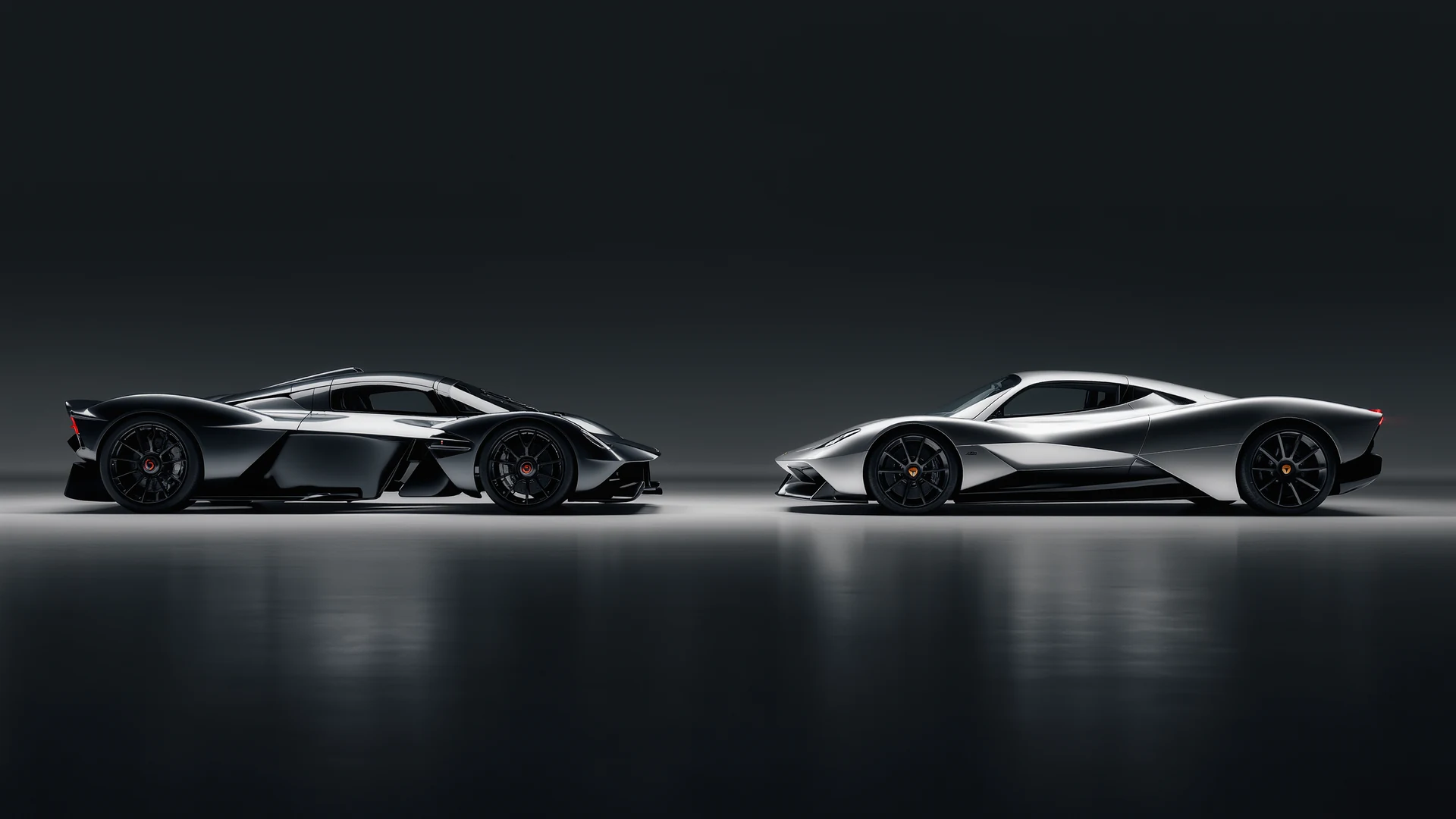
A supercar is a low-volume production machine with 500 to 800 horsepower, while a hypercar starts near 1,000 horsepower with extreme exclusivity, radical engineering and prices beginning above 1.5 million dollars.
Key Takeaways
- Supercars deliver between 500 and 800 horsepower, reach 0 to 100 km/h in 2.5 to 3.5 seconds, and top out at 320 to 350 km/h, with pricing from 200,000 to 800,000 dollars.
- Hypercars begin around 1,000 horsepower and reach upward to 1,914 horsepower in the Rimac Nevera, which sprints 0 to 100 km/h in 1.81 seconds and breaks the 400 km/h barrier.
- Production volume separates the categories: Ferrari builds roughly 8,000 to 10,000 cars a year, while Koenigsegg makes only 35 and Pagani has produced fewer than 500 cars in 25 years.
- Hypercars invent new engineering, such as Bugatti's 16-cylinder W16, Koenigsegg's camshaft-free Freevalve system, and Rimac's 800-volt electrical architecture.
- Hypercar pricing starts above 1.5 million dollars, with limited editions like the Bugatti La Voiture Noire at 11 million euros and the Rolls-Royce Boat Tail at 28 million dollars.
- The Aston Martin Valkyrie is an all-carbon-fiber hypercar weighing about 1,000 kg while producing 1,160 horsepower and targeting cornering forces near 3.0 g.
- Bridge cars blur the line: the Ferrari SF90 Stradale and McLaren Speedtail hit hypercar performance, but volume or branding keeps their classification contested.
The terms “supercar” and “hypercar” circulate freely in automotive journalism, social media, and casual conversation, often used interchangeably despite representing fundamentally different categories of vehicle. In the rarified circles of high-end automotive collecting, manufacturing, and competition, the distinction carries profound meaning. Understanding where the boundary lies illuminates the true hierarchy of the world’s most extraordinary machines and reveals why some cars become legends while others remain merely exceptional.
Defining the Supercar: Performance Elevated to Art
The supercar occupies a unique position in the automotive landscape, it is simultaneously an engineering achievement and a cultural artifact. Understanding what qualifies as a supercar requires examining its performance benchmarks, production realities, and cultural significance.
The Performance Baseline
Supercars establish themselves through quantifiable performance metrics that far exceed conventional sports cars. The modern supercar delivers between 500 and 800 horsepower, achieves 0bis100 km/h (0bis62 mph) in 2.5 to 3.5 seconds, and reaches top speeds between 320 and 350 km/h (199bis217 mph). These numbers represent a genuine leap beyond what mere “sports cars” can accomplish.
The Ferrari 488 GTB exemplifies the modern supercar template: 660 horsepower from a twin-turbocharged V8, 0bis100 km/h in 3.0 seconds, and a top speed of 330 km/h. The Lamborghini Huracán Tecnica delivers 640 horsepower and comparable acceleration figures. The McLaren 720S pushes further with 710 horsepower and 0bis100 km/h in 2.9 seconds, approaching the boundary where supercars begin transitioning toward hypercar territory.
Everyday Usability as a Defining Characteristic
A crucial but often overlooked supercar characteristic is genuine road usability. Modern supercars feature comfort-oriented driving modes, reasonably compliant suspension systems, functional climate control, and infotainment systems comparable to luxury sedans. A Ferrari 488 or McLaren 720S can comfortably complete a cross-continent grand tour. This usability separates supercars from their more extreme relatives, the track-focused specials and the hypercars that prioritize performance over comfort.
Production Volumes and Accessibility
Supercars are production vehicles, albeit low-volume ones. Ferrari produces approximately 8,000bis10,000 cars annually across its entire range. Lamborghini has built over 20,000 Huracáns since its 2014 introduction. McLaren manufactured approximately 5,000 units of the 720S and its variants. These numbers mean that a determined buyer with sufficient resources can eventually acquire a supercar, waiting lists exist but are measured in months, not years or decades.
The Price Spectrum
Supercar pricing typically ranges from $200,000 to $800,000 at MSRP, though options, customizations, and market dynamics can push specific examples higher. A base Ferrari 296 GTB starts around $340,000; a well-optioned example reaches $450,000. The Porsche 911 Turbo S, arguably the entry point to the supercar category, starts around $230,000. This pricing makes supercars aspirational but not entirely out of reach for successful professionals, entrepreneurs, and serious enthusiasts.
Iconic Supercars Through History
The supercar lineage traces back to the Lamborghini Miura (1966), widely considered the first supercar. Its mid-engine layout, breathtaking styling by Bertone, and 280 km/h top speed established the template. The Ferrari F40 (1987) pushed the concept further with its twin-turbocharged V8 and raw, uncompromising character. The McLaren F1 (1992) blurred the line between supercar and hypercar with its 386 km/h top speed, 627 horsepower, and central driving position.
Contemporary supercars like the Ferrari 296 GTB, Lamborghini Revuelto, and Aston Martin DBS Superleggera continue this tradition, extraordinary performance wrapped in designs that evoke emotion and aspiration.
Defining the Hypercar: The Pinnacle of What Is Possible
If a supercar represents the exceptional, a hypercar represents the barely possible. The category exists at the intersection of extreme performance, radical engineering, extreme exclusivity, and cultural significance that transcends the automotive world.
The Performance Threshold
Hypercars operate in a performance realm that makes supercars seem almost ordinary by comparison. Power outputs begin around 1,000 horsepower and range upward to 1,850 horsepower in the Koenigsegg Gemera and 1,914 horsepower in the Rimac Nevera. Acceleration from 0bis100 km/h falls below the 2.5-second barrier, with the Nevera achieving the sprint in 1.81 seconds. Top speeds push toward and beyond 400 km/h (249 mph), with the Bugatti Chiron Super Sport 300+ reaching 490.48 km/h (304.77 mph).
These numbers are not incremental improvements on supercar performance, they represent step changes made possible by fundamentally different approaches to engineering.
The Engineering Revolution
Where supercars adapt and refine existing technologies, hypercars invent entirely new ones. Bugatti’s W16 engine, essentially two narrow-angle V8 engines sharing a crankshaft, required solving thermal management, vibration, and packaging challenges that had defeated every previous attempt at such a configuration. Four turbochargers, 64 valves, and 8.0 liters of displacement working in concert produce 1,600 horsepower in a package that fits behind the driver.
Koenigsegg’s Freevalve Revolution
Christian von Koenigsegg’s Freevalve technology eliminates the camshaft entirely, replacing it with pneumatic actuators that open and close each valve independently under computer control. This allows infinite variability in valve timing, duration, and lift, theoretically enabling a single engine to optimize for efficiency at low speeds and maximum power at high speeds in ways impossible with conventional valve trains. The Koenigsegg Gemera’s 2.0-liter three-cylinder engine produces 600 horsepower using this technology, 300 horsepower per liter, a figure unmatched by any production engine.
Rimac’s 800-Volt Architecture
The Rimac Nevera’s electrical system operates at 800 volts, double the voltage of most electric vehicles, enabling faster charging, reduced current for the same power output, and thinner, lighter wiring throughout the vehicle. This architecture, combined with a 120 kWh battery pack and four independent electric motors (one per wheel), produces 1,914 horsepower and 2,360 Nm of torque while enabling the sophisticated torque vectoring that makes the Nevera’s handling physics-defying.
Exclusivity as Fundamental Architecture
Hypercar exclusivity operates on an entirely different plane from supercar production. Bugatti has built approximately 500 Chirons across all variants. Koenigsegg’s annual production of 35 cars means the company has produced fewer vehicles in its entire 30-year history than Ferrari produces in a single month. Pagani’s total production across all models, Zonda, Huayra, and Utopia, numbers fewer than 500 cars over 25 years.
This scarcity is not a marketing strategy but a manufacturing reality. Each Pagani Utopia requires over 4,000 hours of hand craftsmanship. Every carbon fiber weave pattern on a Koenigsegg must be precisely oriented. These are not cars built on assembly lines but automotive sculptures constructed by teams of artisans.
The Price of Admission
Hypercar pricing begins where supercar pricing ends. Entry-level hypercars start above $1.5 million, with typical pricing between $2 million and $5 million. Limited editions and special commissions push into eight-figure territory, the Bugatti Centodieci at €8 million, the Bugatti La Voiture Noire at €11 million before taxes, the Rolls-Royce Boat Tail at $28 million. These prices reflect not just the cost of materials and labor but the value of access to something genuinely unavailable to all but a handful of people on Earth.
The Performance Divide: Quantifying the Gap
Understanding the performance gulf between supercars and hypercars requires examining specific metrics across multiple dimensions. The differences are not marginal but categorical.
Acceleration: Breaking the 2-Second Barrier
The fastest supercars, the Ferrari SF90 Stradale, the Lamborghini Revuelto, the Porsche 911 Turbo S, achieve 0bis100 km/h in the 2.5bis2.8 second range. This represents the practical limit of rear-wheel or all-wheel-drive combustion vehicles on street tires. Breaking below 2.5 seconds requires overcoming fundamental physics challenges: tire grip limits, weight transfer dynamics, and the instant torque delivery that only electric motors can provide.
The Rimac Nevera’s 1.81-second 0bis100 km/h time, verified by independent testing, demonstrates the hypercar’s ability to transcend these limits. The Pininfarina Battista (1.86 seconds) and the Lotus Evija (under 3.0 seconds, though not independently verified in the same category) further illustrate that the hypercar acceleration frontier now resides firmly in sub-2.0-second territory.
Top Speed: The 400 km/h Frontier
The 400 km/h barrier represents the symbolic dividing line between supercar and hypercar top-speed capability. Supercars typically reach 320bis350 km/h, extraordinarily fast by any standard but within the realm of what production-based aerodynamics can accomplish. Breaking 400 km/h requires dedicated aerodynamic development, specialized tires capable of withstanding the forces involved, and powertrains that can sustain maximum output for extended periods against rapidly increasing aerodynamic drag.
The Bugatti Chiron Super Sport 300+ (490 km/h), the Koenigsegg Jesko Absolut (theoretically capable of 500+ km/h), and the SSC Tuatara (claimed 508 km/h) operate in a realm where tire integrity, aerodynamic stability, and driver survival become the primary engineering considerations. These speeds require specially prepared surfaces (Ehra-Lessien’s 8.7-kilometer straight), tire development programs costing millions, and safety protocols that resemble aerospace rather than automotive procedures.
Lateral Grip and Handling Dynamics
The handling differences between supercars and hypercars manifest most dramatically in lateral acceleration, the cornering forces a vehicle can sustain. A top-tier supercar typically achieves 1.05bis1.15 g on street tires. The McLaren Senna, which straddles the supercar-hypercar boundary, achieves approximately 1.6 g on track-oriented tires. The Aston Martin Valkyrie, an undisputed hypercar, targets lateral acceleration figures approaching 3.0 g, levels that require F1-derived active aerodynamics and would cause most drivers to lose consciousness without proper conditioning.
Materials and Construction: Carbon Fiber vs. Compromise
The construction methods employed by supercars and hypercars reveal perhaps the most fundamental difference between the two categories, the extent to which cost and practicality are permitted to influence engineering decisions.
Supercar Construction
Modern supercars employ aluminum-intensive construction with carbon fiber used selectively for specific components. The Ferrari 488’s chassis combines aluminum extrusions, castings, and sheet metal, a sophisticated approach that balances weight, cost, repairability, and production efficiency. The Lamborghini Huracán’s hybrid aluminum-carbon chassis follows similar principles. These are genuine performance structures, but they represent compromises between ideal engineering solutions and production practicalities.
Hypercar Construction: No Compromises
Hypercar construction tolerates no such compromises. The Bugatti Chiron’s carbon fiber monocoque is engineered to withstand forces far beyond any conceivable road scenario while weighing less than a comparable aluminum structure would. The Koenigsegg Jesko’s carbon fiber tub incorporates formula-style fuel cell integration and structural elements that double as aerodynamic components. The Pagani Utopia’s Carbo-Titanium, a proprietary carbon-titanium composite, represents materials science as much as automotive engineering.
The Aston Martin Valkyrie carries this philosophy to its logical extreme: the entire vehicle is effectively a carbon fiber structure with a powertrain attached. There is no steel subframe, no aluminum crash structure, no metal components beyond those absolutely necessary (the engine internals, the gearbox, the fasteners). The result is a vehicle that weighs approximately 1,000 kg (2,200 lbs) while producing 1,160 horsepower, a power-to-weight ratio exceeding that of most racing cars.
The Titanium and Inconel Frontier
Hypercars employ exotic materials throughout, not merely in their primary structures. The Bugatti Chiron’s exhaust system incorporates titanium to save weight while withstanding temperatures that would melt conventional stainless steel. The Koenigsegg Jesko’s turbocharger turbine wheels are machined from Inconel, a nickel-based superalloy developed for jet engine turbine blades. The Pagani Huayra’s suspension components are CNC-machined from billet aluminum and titanium alloys, each piece taking hours to produce from solid blocks of metal.
Comparative Analysis: Head-to-Head Case Studies
Examining specific vehicle comparisons crystallizes the supercar-hypercar distinction in ways that abstract definitions cannot. These head-to-head analyses reveal how the categories manifest in real vehicles that occupy adjacent market positions.
Lamborghini Huracán STO vs. Lamborghini Countach LPI 800-4
The Huracán STO (Super Trofeo Omologata) represents the supercar taken to its logical extreme, a road-legal version of Lamborghini’s Super Trofeo race car, producing 640 horsepower from a naturally aspirated V10, achieving 0bis100 km/h in 3.0 seconds, and priced around $330,000. Lamborghini will build as many STOs as demand supports over its production run.
The Countach LPI 800-4, by contrast, is a hypercar despite sharing some underpinnings with the Aventador. Limited to 112 units (a reference to the original Countach’s internal LP 112 designation), priced at $2.64 million, and featuring hybrid technology derived from the Sián FKP 37, the Countach LPI 800-4 operates on an entirely different plane of exclusivity. Its 814-horsepower hybrid V12 delivers performance that, while numerically similar to many supercars, is delivered with a sense of occasion and rarity that transforms the experience. Every Countach LPI 800-4 was allocated before its public reveal, a characteristic hypercar phenomenon.
Ferrari 296 GTB vs. Ferrari Daytona SP3
The Ferrari 296 GTB exemplifies the modern supercar: an 819-horsepower plug-in hybrid V6, 0bis100 km/h in 2.9 seconds, priced from $340,000, and produced in the thousands. It represents Ferrari’s series-production future, extraordinary performance accessible to Ferrari’s traditional customer base.
The Daytona SP3, part of Ferrari’s Icona series, occupies hypercar territory. Limited to 599 units, priced at $2.3 million, and featuring a naturally aspirated 828-horsepower V12 derived from the 812 Competizione, the SP3 channels the spirit of Ferrari’s 1967 24 Hours of Daytona 1-2-3 finish. Its design references the 330 P4, 350 Can-Am, and 512 S, creating a direct lineage to motorsport history that the 296 GTB, however brilliant, cannot claim. The SP3’s production was allocated entirely to existing Ferrari collectors, many of whom had never been offered a limited-series Ferrari before.
Porsche 911 GT2 RS vs. Porsche 918 Spyder
The Porsche 911 GT2 RS (991 generation) represents the most extreme road-going 911 ever built: 700 horsepower, rear-wheel drive, 0bis100 km/h in 2.8 seconds, priced at $293,000. Production was limited only by Porsche’s manufacturing capacity over the model’s run, and examples remain readily available on the secondary market.
The 918 Spyder, Porsche’s entry in the hybrid hypercar trinity, operated on an entirely different level. Its $845,000 base price, 918-unit production cap, and 887-horsepower hybrid powertrain placing it alongside the LaFerrari and P1 in automotive history. The 918’s carbon fiber monocoque, derived from Porsche’s LMP1 racing program, and its pioneering hybrid system, capable of electric-only operation at speeds up to 150 km/h, represented technologies that the GT2 RS, despite its formidable track performance, simply did not possess. Today, 918 Spyders trade at significant premiums to their original prices while GT2 RS values have remained relatively flat.
The Gray Zone: Cars That Defy Classification
Several modern vehicles deliberately blur the boundary between supercar and hypercar, creating a contested territory that enriches both categories. These “bridge cars” demonstrate that the distinction, while useful, is not absolute.
The Ferrari SF90 Stradale
Ferrari’s plug-in hybrid SF90 Stradale defies easy categorization. Its 986 horsepower from a twin-turbocharged V8 and three electric motors approaches hypercar territory. Its all-wheel-drive system, enabled by the front-axle electric motors, delivers acceleration (0bis100 km/h in 2.5 seconds) that challenges genuine hypercars. Yet Ferrari positions it within its regular series-production range, and the company has built thousands of units, volumes that disqualify it from hypercar status on exclusivity grounds.
The McLaren Speedtail
McLaren’s Speedtail occupies an even more ambiguous position. Limited to 106 units, priced at £1.75 million (plus taxes), and capable of 403 km/h, it meets the exclusivity, pricing, and top-speed criteria for hypercar status. Its 1,050-horsepower hybrid powertrain and three-seat central driving position are genuinely innovative. Yet McLaren itself categorizes the Speedtail as part of its “Ultimate Series” alongside the Senna, avoiding the “hypercar” label while clearly building a vehicle that operates in hypercar territory.
The Koenigsegg Gemera: A Category of One
The Gemera fundamentally challenges the supercar-hypercar taxonomy. With four seats, four-wheel drive, four-wheel steering, and a hybrid powertrain producing 2,300 horsepower, it combines hypercar performance with practical grand touring capability in a way no previous vehicle has attempted. Its 2.0-liter three-cylinder Freevalve engine alone produces 600 horsepower, more than many supercars’ V8s, before the three electric motors contribute their additional 1,700 horsepower. The Gemera suggests that the future may require entirely new categories to describe vehicles that transcend current definitions.
The Evolution of Both Categories
The supercar-hypercar distinction itself continues evolving as technology democratizes performance and electrification rewrites the rules. Understanding where both categories are headed provides context for evaluating individual vehicles and the market dynamics that surround them.
Technology Trickle-Down
Technologies pioneered in hypercars inevitably migrate to supercars and eventually to mainstream vehicles. Carbon fiber construction, once exclusive to hypercars, now appears in moderately priced sports cars. Active aerodynamics, movable wings, adjustable splitters, deployable spoilers, originated on hypercars but are now available on vehicles like the Porsche 911 Turbo. The hybrid systems that debuting in the LaFerrari, P1, and 918 Spyder now appear in vehicles across the performance spectrum.
The Electrification Convergence
Electric powertrains complicate the traditional performance hierarchy. The Rimac Nevera and Pininfarina Battista out-accelerate every combustion hypercar ever built. The Lotus Evija targets similar performance at a (relatively) lower price point. As electric powertrains become more common, the performance differentiation that defined the supercar-hypercar boundary may shift from power and acceleration to other dimensions, range, charging speed, software sophistication, and digital ecosystem integration.
Ultimately, the distinction between supercar and hypercar reflects more than performance numbers or price tags. A supercar is an achievement, a vehicle that pushes the boundaries of what production automotive engineering can accomplish. A hypercar is a declaration, a statement that the manufacturer will pursue automotive perfection without regard for cost, practicality, or convention. Both categories represent the pinnacle of human creativity and engineering applied to the art of motion.
Frequently Asked Questions (FAQ)
What is the main difference between a supercar and a hypercar?
A supercar is a low-volume production vehicle producing 500 to 800 horsepower with genuine road usability, while a hypercar starts near 1,000 horsepower, uses radical new engineering, and is built in extremely limited numbers. The article frames the supercar as an achievement and the hypercar as a declaration of pursuing perfection regardless of cost or convention.
How much horsepower does a hypercar have compared to a supercar?
Hypercar power outputs begin around 1,000 horsepower and climb to 1,850 horsepower in the Koenigsegg Gemera and 1,914 horsepower in the Rimac Nevera. Supercars, by contrast, deliver between 500 and 800 horsepower. Examples include the Ferrari 488 GTB with 660 horsepower and the McLaren 720S with 710 horsepower, which approaches the boundary toward hypercar territory.
How fast is the Rimac Nevera from 0 to 100 km/h?
The Rimac Nevera accelerates from 0 to 100 km/h in 1.81 seconds, a figure verified by independent testing. This sub-2-second performance is enabled by its 1,914 horsepower, four independent electric motors, and 800-volt architecture. The article notes that breaking below 2.5 seconds requires the instant torque delivery that only electric motors can provide.
What is the price range of a hypercar versus a supercar?
Hypercar pricing begins above 1.5 million dollars, with typical examples between 2 million and 5 million dollars. Supercars range from 200,000 to 800,000 dollars at MSRP. Limited editions push far higher, such as the Bugatti Centodieci at 8 million euros, the La Voiture Noire at 11 million euros, and the Rolls-Royce Boat Tail at 28 million dollars.
Why are hypercars so much rarer than supercars?
Hypercar scarcity is a manufacturing reality, not a marketing strategy. Bugatti has built roughly 500 Chirons, Koenigsegg produces only 35 cars a year, and Pagani has made fewer than 500 cars in 25 years. Each Pagani Utopia requires over 4,000 hours of hand craftsmanship, making these vehicles automotive sculptures built by artisans rather than assembly lines.
Is the Ferrari SF90 Stradale a supercar or a hypercar?
The Ferrari SF90 Stradale defies easy categorization. Its 986 horsepower and 2.5-second 0 to 100 km/h time approach hypercar territory, yet Ferrari positions it within its regular series-production range and has built thousands of units. Those high volumes disqualify it from hypercar status on exclusivity grounds, making it a bridge car between the two categories.
What top speed defines the supercar to hypercar boundary?
The 400 km/h barrier marks the symbolic dividing line. Supercars typically reach 320 to 350 km/h, while hypercars push toward and beyond 400 km/h. The Bugatti Chiron Super Sport 300+ reached 490.48 km/h, and the Koenigsegg Jesko Absolut is theoretically capable of over 500 km/h. Such speeds demand dedicated aerodynamics and specialized tires.
Which car is considered the first supercar?
The Lamborghini Miura from 1966 is widely considered the first supercar. Its mid-engine layout, breathtaking styling by Bertone, and 280 km/h top speed established the template. The lineage continued through icons like the Ferrari F40 in 1987 and the McLaren F1 in 1992, which blurred the supercar and hypercar line with its 386 km/h top speed.
What is the difference between a supercar and a hypercar?
How much faster is a hypercar than a supercar?
What role does production volume play in the classification?
More from Blog
The Future of Hypercars: Electrification, Autonomy, and the Next Performance Frontier
The future of hypercars: how electrification, solid-state batteries, hybrid V16 powertrains, 3D printing, active aero, autonomy and eFuels redefine pe…
Hypercar Maintenance Guide: The True Cost of Keeping an Automotive Masterpiece on the Road
Hypercar maintenance guide: real annual service costs from Bugatti and Koenigsegg to Pagani and Rimac, plus tire, brake and resale-value insights for …
Hypercar Events Worldwide: The Ultimate Calendar for Collectors and Enthusiasts
Hypercar events worldwide: a collector’s calendar from Monterey Car Week and Goodwood to Villa d’Este, Top Marques Monaco, elite rallies a…